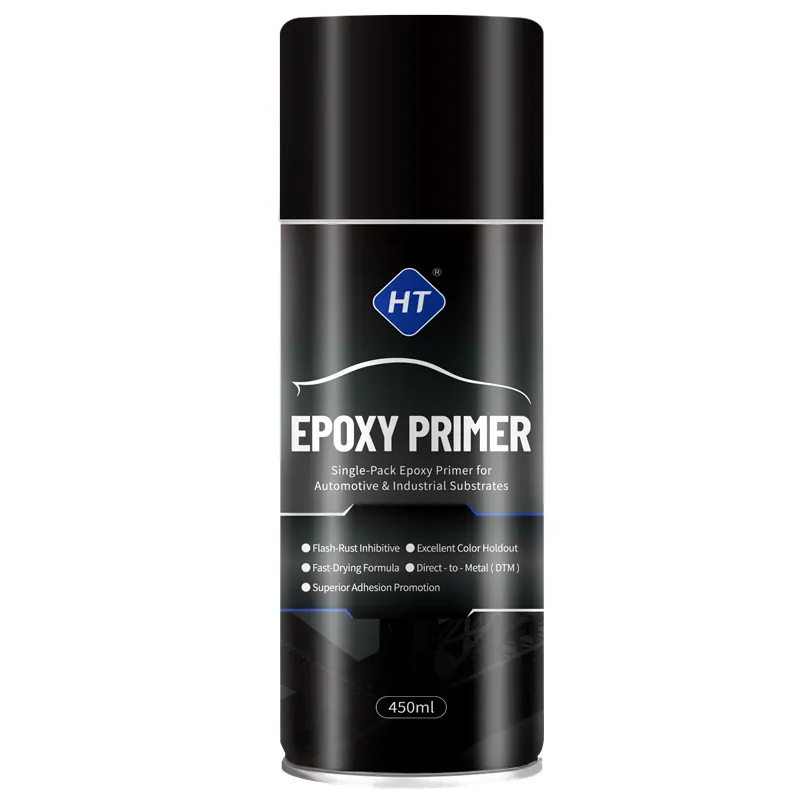
What makes epoxy primer different from standard spray primer?
The fundamental difference is chemistry. Epoxy primers use epoxy resin as the binder instead of alkyd or acrylic. This gives them three key advantages:
- Chemical bonding: Epoxy reacts with the substrate surface to form a cross-linked molecular bond. This is far stronger than the mechanical adhesion of standard primers.
- Corrosion resistance: Epoxy creates a dense barrier that resists moisture, salt spray, and chemical attack. Salt spray resistance ratings of 500-1000+ hours are common.
- Hardness: Cured epoxy films are significantly harder than acrylic or alkyd, providing impact and abrasion resistance.
Trade-offs: Epoxy primers are typically less UV-stable than polyurethane (they chalk/yellow in sunlight). They also require proper mixing or shaking. A true two-part epoxy needs an activator, but single-component epoxy-ester aerosols offer a practical compromise for many applications.
For B2B buyers, the choice between standard and epoxy primer depends on the end-use environment. For indoor industrial equipment, machinery, and structural steel, epoxy is the superior choice.
What industries use epoxy primer spray paint most?
Epoxy primer is specified across multiple industrial sectors:
- Heavy equipment manufacturing: Construction, mining, and agricultural machinery require the best possible corrosion protection. Epoxy primer is the standard OEM spec.
- Marine and offshore: Vessels and offshore structures face constant salt spray exposure. Epoxy primer systems with 1000+ hour salt spray resistance are mandatory.
- Industrial maintenance (MRO): Refineries, chemical plants, and power generation facilities use epoxy primer for structural steel and equipment recoating.
- Automotive aftermarket: Chassis and underbody components exposed to road salt and moisture.
- Metal fabrication: Structural steel, bridges, railings, and industrial pipe systems.
Demand for epoxy primer aerosols is growing in the MRO segment because aerosol format lets maintenance crews do spot repairs without needing spray equipment.
How do you specify an epoxy primer for OEM production?
When sourcing an epoxy primer spray from an OEM manufacturer, this is what matters:
- Substrate compatibility: Specify the target substrates — steel, aluminum, galvanized metal, concrete, or plastic. Each requires a different epoxy formulation. For galvanized steel, you need a specialized etching epoxy.
- Performance testing: Request salt spray resistance test data (ASTM B117). Minimum 500 hours for indoor, 1000+ hours for outdoor/coastal. Also verify adhesion (ASTM D3359) and impact resistance (ASTM D2794).
- Application properties: Dry film thickness per coat (typically 25-50 microns), recoat window (how soon you can apply topcoat), and drying time at ambient temperature.
- Regulatory compliance: VOC limits vary by region. Typical industrial epoxy primers range from 340-500 g/L. Ensure the formulation meets your target market's regulations.
- Color options: Most epoxy primers come in grey, red oxide, and zinc yellow. Custom colors are available for OEM orders above minimum quantities.
- Compatibility with topcoats: The primer must work with the intended topcoat system — polyurethane, acrylic, or alkyd. Delamination between primer and topcoat is a common field failure.
What surface preparation is required for epoxy primer?
Surface preparation is critical for epoxy primer performance. Unlike standard primers that can tolerate moderate surface rust, epoxy requires a clean, properly profiled surface:
- Steel: Abrasive blast cleaning to Sa 2.5 (near-white metal) is ideal. For hand-prep, use a wire brush and sandpaper to remove all loose rust, mill scale, and contaminants. A surface profile of 50-100 microns is recommended.
- Aluminum: Light abrasion with 180-220 grit sandpaper, then clean with a degreaser. Aluminum naturally forms an oxide layer that must be removed or etched for proper adhesion.
- Concrete: Clean, dry, and free of curing compounds. Acid etching or mechanical profiling is recommended for new concrete.
- Previously painted surfaces: Feather-sand to blend edges, remove all loose paint, and clean thoroughly. Epoxy over incompatible coatings can delaminate.
- Environmental conditions: Apply between 50-95 deg F (10-35 deg C). Maximum relative humidity 85%. Epoxy is less sensitive to humidity than most paints, but surface moisture is still a problem.
Proper surface preparation accounts for 70-80% of coating system performance. An epoxy primer applied to poorly prepared steel will fail, and the failure mode (cathodic disbondment) can be more severe than with standard primers.