Where does a mower deck rust first?
The underside, then the edges. Wet grass clippings pack against bare steel and stay damp for days, so the deck shell, the discharge chute and the skirt around the blades go first while the top side still looks tidy. Once paint flakes on the top surface, the rust has usually already gone through in one or two spots.
What decides whether the deck is worth repainting?
How the metal behaves under a scraper. Surface rust that leaves solid dark steel is a repaint job. Scale that comes off in flakes, or a scraper tip that sinks through, means perforation, and that area needs welding or a replacement deck. Check the spindle housings, deck hangers and wheel brackets the same way. A structurally sound deck gets years out of a proper recoat; a rotten one just wastes a Saturday.
How do you prep a deck properly?
Drop the deck off the machine if the design allows it. Working underneath a mounted deck is how half the surface gets missed:
- Scrape caked grass and loose paint with a putty knife and a wire brush. Rust has to be exposed, not painted over.
- Remove the blades and set them aside for sharpening. Do not paint blades; sharpening and balance are what matter, and a thick coating on a blade is a hazard, not a finish.
- Degrease, pressure wash, then let the deck dry completely, ideally a full day in the sun. Water sits in the seams around the spindle housings, and coating a damp seam guarantees a rust bloom under the new paint.
- Mask the engine, belts, pulleys, cables and blade mounting hardware.
Where does HT-020 fit?
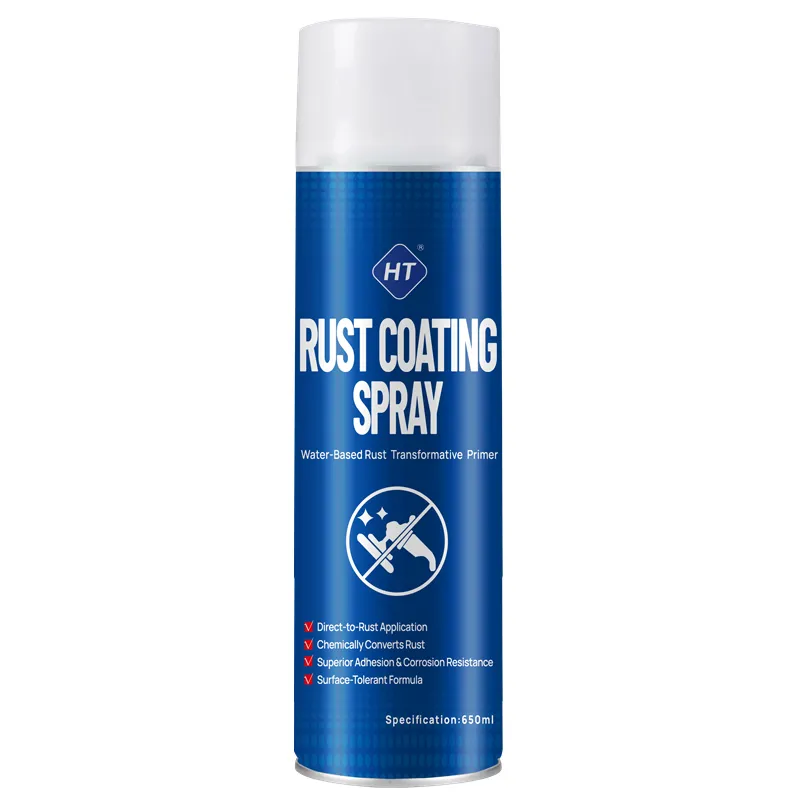
HT-020 is a water-based rust transformative primer built for direct-to-rust application, so the brown oxidation left in the pits is treated rather than sealed under paint. One can covers roughly 10-15 sq ft, about one full coat on a 21-inch walk-behind deck. It handles the shell, the chute and the skirt, and it goes on as the primer layer for whatever follows.
What goes over the primer, and how many coats?
A hard-wearing topcoat, because on a deck the enemy is abrasion from stones and grass. A coating built for that job, such as HT-027, outlasts a decorative enamel by seasons:
- Two coats of HT-020 over the rusted areas, then two light topcoats.
- Keep the film thin at the edges and around the spindle openings. Heavy paint bridging a seam cracks as soon as the deck flexes.
- Allow 24 hours before any use and 48 hours before wet grass. A coating has to be hard, not merely dry.
Why do deck repaints fail within one season?
Three failure modes come up again and again:
- Coating damp or greasy steel. Grass juice is acidic and oily; if the deck is not degreased and bone dry, the film lifts in patches.
- Painting in the cold. Decks usually get repainted in October when the season ends and the temperature has already dropped, which slows the cure and kills adhesion. If the work cannot be done above roughly 15 C, wait for spring.
- Treating only the visible side. Rust comes back from the underside up, so a deck coated only on top is flaking again by midsummer.
What should be left unpainted, and what about aluminium decks?
Leave the blades, spindle bearings, grease fittings, belts, pulleys and engine alone. A rust converter belongs on steel only. On an aluminium deck the oxidation is white and powdery rather than brown, so HT-020 is not the right product there: clean the alloy, use an etch primer, and keep coats thin, because blade tip clearance under a deck is a few millimetres and thick paint in the blade path rubs.