What is CUI, and why is it the most expensive corrosion on a plant?
Corrosion under insulation is external corrosion of steel kept at a temperature where outside water cannot evaporate. On carbon steel the damage is most severe where the surface cycles in the range where liquid water exists - commonly quoted as roughly minus 12 to 175 degrees Celsius - and worst of all on lines that run hot and then cool down, because the water is pulled in during every cool-down.
Three things make it costly:
- It is invisible. Nothing on the outside of a jacket shows that the pipe behind it has lost section.
- Finding it costs money. Inspection means opening insulation, and each opening is a repair in itself.
- It is found late: as a leak, a shutdown extension, or a fitness-for-service problem.
Austenitic stainless adds a second failure mode: external chloride stress corrosion cracking, which needs no liquid pool, only chloride deposits and elevated temperature.
Why doesn't a normal protective coating solve CUI on its own?
Because insulation changes the conditions a coating has to survive. Instead of a surface that dries, the film sits under:
- water arriving from outside and trapped against the steel;
- mechanical load from the insulation and its supports;
- elevated temperature for years at a time;
- concentrated chlorides and other species left behind as water evaporates.
Generic primers and enamels are not qualified for that exposure. Insulated-service coatings must be tested to a recognised CUI protocol - ISO 19277 is the usual reference - or specified by the owner to an equivalent standard.
And the honest limit: where insulation stays permanently wet, no coating survives. If drainage or jacketing is the real problem, fix that first - coating a surface that never dries is money spent twice.
Where does the water actually get in?
Almost always at details, and almost always from above:
- Damage or unsealed laps in the jacketing, especially after scaffolding, hot work, or access.
- Open terminations at the top of vertical runs, where water tracks down the annular space.
- Penetrations and clip fixings for instruments, ladders, platforms, and supports.
- Failed sealant at joints and at hanger locations.
- Low points and drains that hold water instead of shedding it.
- Washdown and deluge water directed at insulation, plus process spillage nearby.
- Insulation left open during construction or a postponed job - the fastest way to start a CUI site.
Remember the pattern: water enters at the top and shows up at the bottom, so high-point terminations and the first metre below them deserve attention first.
How do you find CUI without stripping every line?
With a risk ranking and a set of targets, rather than a blanket approach:
- Rank by age, insulation condition, coastal or deluge exposure, steam and cyclic service, and history.
- Walk the jacketing first. Dents, open laps, failed sealant, staining, and missing cladding tell you where to look.
- Thermography shows wet insulation but does not detect corrosion - treat it as a pointer, not evidence.
- Use guided wave or ultrasonic screening profiles on long insulated runs, then confirm suspect spots directly.
- Cut planned inspection windows at high-risk details so the openings are deliberate and repairable.
Whatever the method, record it: location, condition, thickness readings, reinstatement. CUI is managed as a programme over years, and an unrecorded inspection has no value to the next shutdown.
How should steel be coated before the insulation goes back?
In this order, and the sequence matters as much as the product:
1. Remove insulation, assess and record the steel condition, and clean to the specified standard - abrasive blast where the scope allows, power-tool prep for spot repairs.
2. Apply the CUI-qualified system to its specified thickness, with stripe coats on edges, welds, and supports.
3. Reinstate jacketing with sealed laps and properly designed terminations, because the coating only works if water stops arriving.
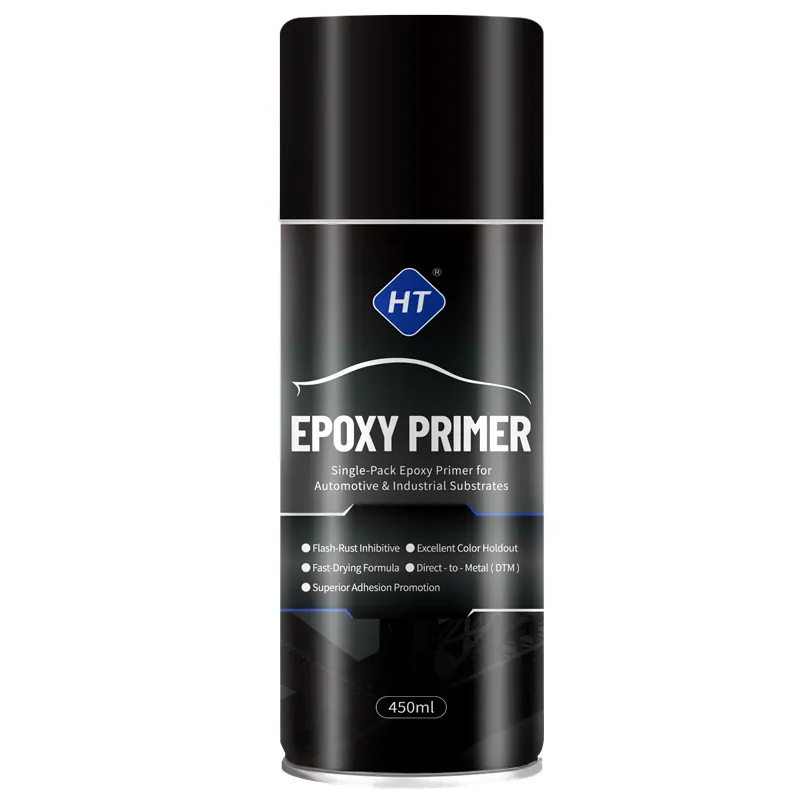
4. Repair small areas after shutdown work with products from the same approved system - our HT-017 zinc-rich primer and HT-031 epoxy primer where that system allows.
What not to do is substitute a convenient product for a qualified layer: whoever signs off the line's integrity will ask what was applied.
What kind of programme actually prevents CUI?
Five habits, applied consistently:
- Keep jacketing sealed. Every open lap, missing band, or unsealed penetration is a corrosion site from that day forward.
- Control construction and shutdown work: insulation is never left open at the end of a shift, and never reinstated over wet steel.
- Manage washdown and drainage, because water you direct at insulated steel will find its way in.
- Inspect risk-ranked details on a fixed cycle, with records that survive staff changes.
- Train the crew to treat opening insulation as a corrosion event requiring sealing, not just closing.
CUI is rarely a coating failure in isolation. It is a detailing and discipline failure, expressed as corrosion, and it responds to discipline - not to a better can of paint.